
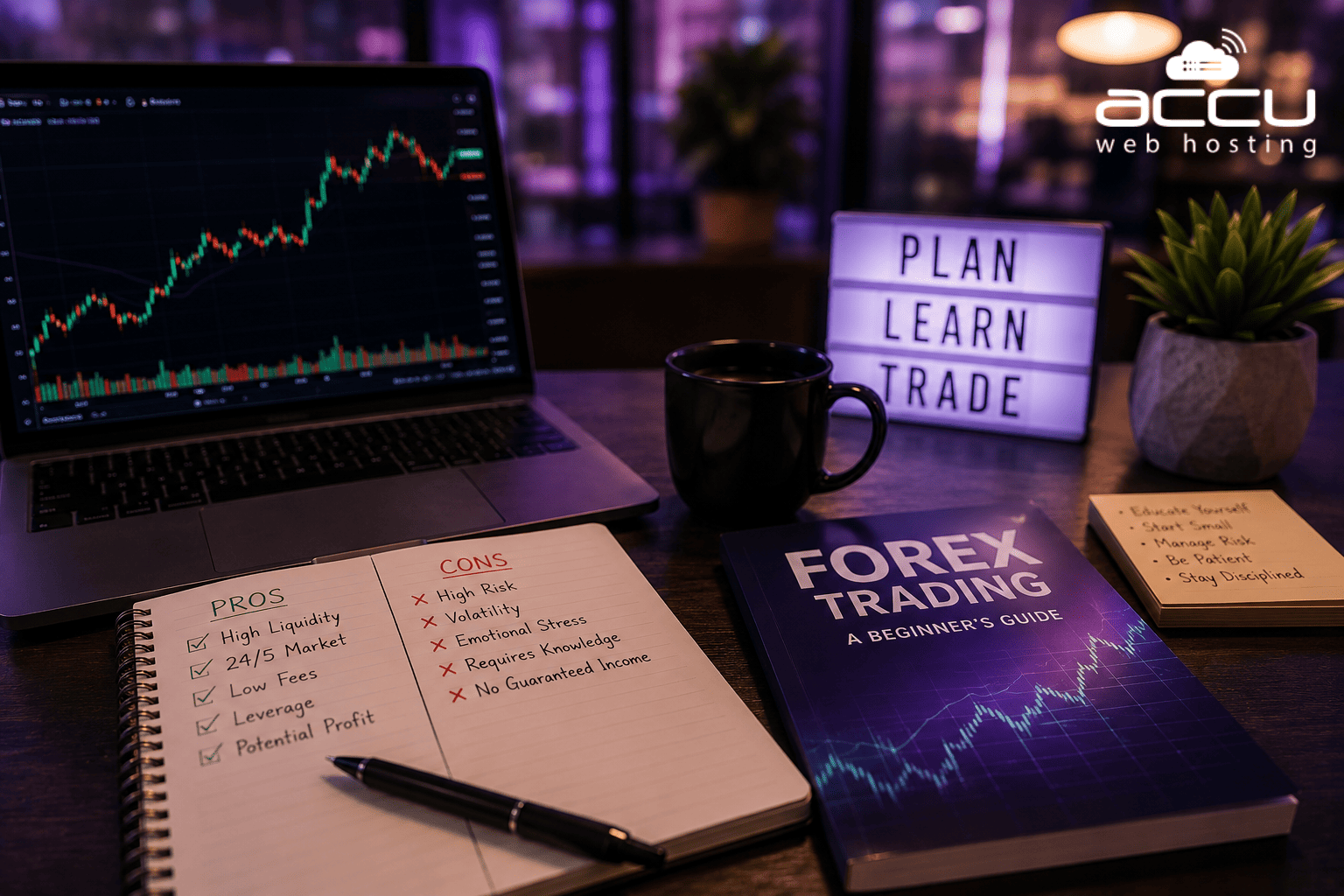
Is Forex trading profitable? This is one of the first questions people ask before entering the foreign exchange market. The answer isn’t simply yes or no. Forex trading can be profitable, but it also involves significant risks, and results depend on how well a trader understands the market and manages those risks.
Unlike traditional investing, Forex trading involves buying and selling currency pairs to potentially profit from changes in exchange rates. Some traders focus on short-term strategies, while others hold positions for longer periods.
So, how profitable is Forex trading?
There is no fixed amount that every trader can earn. Profitability depends on factors such as market knowledge, trading strategy, risk management, capital, discipline, and market conditions. A trader may make profits during some periods and experience losses during others.
In this guide, we’ll look at what affects Forex trading profitability, the potential opportunities, the risks involved, and what traders should consider before putting their money into the market.
Is Forex Trading Profitable?
Forex trading can be profitable, but it is not a way to get rich overnight. There are no guaranteed returns or shortcuts to consistent profits. Traders who enter the market only to make quick money can easily take excessive risks and suffer losses.
However, Forex trading can offer opportunities for people who are willing to learn the market, develop a trading strategy, manage risk carefully, and stay disciplined. Losses are also part of trading, so understanding the risks is just as important as understanding the potential returns.
Before looking at the risks, let’s explore the key factors that attract people to Forex trading.
Factor 1: Forex Is Accessible to Learn
Forex trading does not require a formal degree, but learning the basics still takes time and practice. Anyone interested in the market can learn about currency pairs, trading orders, technical analysis, fundamental analysis, and risk management through courses, guides, and demo trading.
You may be able to understand the fundamentals within a few months, but becoming an experienced trader takes considerably longer. There is no fixed timeline for becoming consistently profitable, as it depends on your knowledge, strategy, practice, and ability to manage risk.
If you plan to run a trading platform or automated trading strategy continuously, a Forex VPS hosting plan can provide an always-on environment for your trading applications. However, using a VPS does not guarantee profits or reduce the financial risks of Forex trading.
Combining technical and fundamental analysis with proper risk management can help you make more informed trading decisions. Before using real money, consider practicing with a demo account and understanding the risks involved.
Factor 2: The Forex Market Operates 24 Hours a Day, Five Days a Week
One advantage of Forex trading is that the market operates 24 hours a day, five days a week during the global trading week. This gives traders more flexibility to choose trading hours that fit their schedules.
Unlike markets with fixed daily opening and closing times, Forex trading takes place across major financial centers around the world. As a result, traders can choose a session that suits their availability rather than having to trade at one specific time.
This flexibility can be useful for people who have other work or personal commitments. However, being able to trade at any time does not mean that every hour offers the same trading opportunities. Market activity and liquidity can vary between trading sessions, so traders should choose their trading hours based on their strategy and the currency pairs they trade.
Factor 3: Leverage Can Increase Both Potential Gains and Losses
Leverage allows Forex traders to control a larger position with a smaller amount of money. For example, with 1:50 leverage, $100 of margin could be used to control a $5,000 position, depending on the broker and account requirements.
The main advantage is that traders can access larger positions without putting the full trade value into their account. However, leverage also increases the risk. Even a small movement in the market against your position can lead to larger losses.
For this reason, beginners should use leverage carefully and avoid taking positions that are too large for their account. Setting a reasonable position size and using stop-loss orders can help keep potential losses under control.
Leverage does not guarantee higher profits. It simply increases the size of the position you can control, which means both potential gains and losses can become larger.
Factor 4: Rising and Falling Prices Create Profit Potential
Forex trading allows traders to potentially profit from both rising and falling currency prices. If you expect a currency pair to increase in value, you can buy (go long). If you expect it to decrease, you can sell (go short).
Because Forex is traded in currency pairs, buying one currency pair means buying the base currency and selling the quote currency. For example, when trading the GBP/USD pair, a trader going long expects the British pound to strengthen against the U.S. dollar. A trader going short expects the pound to weaken against the dollar.
This flexibility allows Forex traders to develop strategies for different market conditions. However, being able to trade in both directions does not guarantee a profit. The market can move against your position, resulting in a loss.
Trading With Leverage Increases Both Profit and Loss Potential
Forex trading often involves leverage, which allows traders to control a larger position with a smaller amount of capital. While this can increase the potential return on a successful trade, it can also increase losses when the market moves in the opposite direction.
The actual profit or loss depends on factors such as the position size, entry and exit prices, leverage, spread, and overall market movement. Traders should understand these risks before using leveraged Forex positions.
Past performance does not guarantee future results. Forex trading involves significant risk, and you may lose some or all of your invested capital.
Factor 5: Low Trading Costs
Forex trading costs are often built into the spread, which is the difference between the bid and ask price of a currency pair. Many retail Forex brokers primarily earn through spreads, while some also charge a separate commission depending on the account and trading model.
For example, if the bid price is 1.4268 and the ask price is 1.4271, the difference is 3 pips. A smaller spread generally means a lower trading cost, although the actual cost depends on factors such as the currency pair, market conditions, trade size, and broker.
A pip is a standard unit used to measure price movements in Forex. For most currency pairs, it represents the fourth decimal place, while for Japanese yen pairs, it generally represents the second decimal place.
Some brokers may offer commission-based accounts with lower spreads, while others may include their costs primarily in the spread. Therefore, traders should compare the spread, commission, and other applicable fees rather than assuming that Forex trading has no commissions or is always low-cost.
Factor 7: Low Barrier to Entry
One reason Forex trading attracts new traders is its relatively low barrier to entry. You don’t necessarily need a large amount of capital or a traditional financial background to start learning about the Forex market.
Many brokers offer demo accounts and different account types, allowing beginners to learn how currency trading works before committing significant capital. However, easy access to the market does not mean that becoming a successful trader is easy.
New traders still need to understand market analysis, trading strategies, position sizing, and risk management. Starting with a smaller amount of capital or using a demo account can help beginners gain experience while limiting their initial exposure to risk.
Factor 8: High Liquidity
Liquidity refers to how easily an asset can be bought or sold without causing a significant change in its price.
The Forex market is known for its high liquidity because currencies are traded in large volumes across global financial markets. This allows traders to generally enter and exit positions quickly, while major currency pairs often have relatively narrow spreads.
High liquidity can also make Forex attractive to traders because there is usually a large number of buyers and sellers in the market. However, liquidity is not the same at all times. It can vary depending on the currency pair, trading session, market conditions, and major economic events.
Therefore, while high liquidity can contribute to efficient trade execution and competitive spreads, it does not guarantee profits. Traders should still consider market volatility, spreads, and liquidity conditions before placing a trade.
Factor 9: You Can Go Long or Go Short
One of the features of Forex trading is the ability to take positions based on both rising and falling prices.
For example, in the GBP/EUR currency pair, GBP is the base currency, and EUR is the quote currency. If GBP/EUR is trading at 1.12287, it means one British pound is worth 1.12287 euros.
If you expect the pound to strengthen against the euro, you can buy the pair (go long). If you expect the pound to weaken against the euro, you can sell the pair (go short).
This flexibility allows traders to develop strategies for different market conditions. However, being able to trade in either direction does not guarantee a profit. The outcome depends on the accuracy of the market analysis, entry and exit points, position size, and risk management.
Forex or Stock Market: Which Is Better?
Choosing between Forex and the stock market depends on your trading goals, risk tolerance, available capital, and preferred trading style. Neither market is automatically better for everyone.
Forex may appeal to traders who prefer flexible trading hours, high liquidity, and the ability to take both long and short positions. However, the use of leverage can also increase losses, so beginners should understand the risks before trading with borrowed exposure.
Stocks may be more suitable for investors who prefer owning shares of individual companies and holding investments for longer periods. Forex, on the other hand, is often used for shorter-term trading based on currency price movements.
Forex vs. Stocks: Key Differences
| Factor | Forex | Stocks |
| Trading hours | Generally available 24 hours a day, 5 days a week | Usually follows the operating hours of the relevant stock exchange |
| Market liquidity | Major currency pairs generally have high liquidity | Liquidity varies significantly between individual stocks |
| Leverage | Leverage is commonly available, depending on the broker and regulations | Leverage availability varies by market, broker, and account type |
| Long/short trading | Traders can generally go long or short | Short selling is available in many markets but may involve additional requirements |
| What you trade | Currency pairs | Shares of publicly traded companies |
| Risk | Leverage and currency volatility can increase losses | Company-specific and market risks can affect investment value |
Which Is Better for Beginners?
There is no single answer. A beginner should choose a market based on their understanding of the asset, risk tolerance, and trading objectives rather than focusing only on potential profits.
Forex can provide flexibility and access to highly liquid currency pairs, but leverage means losses can accumulate quickly. The stock market may offer a different approach, particularly for people interested in investing in individual companies over longer periods.
The goal should not be to find a market where you can “make big money” quickly. It should be to understand the market, manage risk, and choose a trading or investment approach that fits your financial situation.
Is Forex Trading Good for Beginners?
Forex trading can be suitable for beginners who are willing to learn how the market works and understand the risks involved. Before trading with real money, beginners should learn about currency pairs, leverage, spreads, risk management, and basic trading strategies.
Forex is accessible, but that does not mean it is easy to make consistent profits. Beginners should consider starting with a demo account and developing their trading knowledge before risking real capital.
If you plan to run trading platforms or automated strategies continuously, a reliable Forex VPS Hosting plan can help keep your trading environment available without relying on your personal computer.
What’s the Difference Between a Demo and a Live Trading Account?
A demo trading account allows beginners to practice Forex trading using virtual funds without risking real money. It can help you become familiar with the trading platform, test strategies, and understand how orders work.
A live trading account, on the other hand, uses real money, so actual gains and losses are involved. While a demo account can provide a useful introduction to Forex, trading with virtual funds may not fully replicate the emotions and risks involved in live trading.
Can You Get Rich by Trading Forex?
Forex trading can potentially generate profits, but there is no guaranteed way to become rich through Forex trading. Leverage can increase the potential return on a trade, but it can also increase losses.
Consistent trading results require knowledge, a well-tested strategy, proper risk management, and discipline. Beginners should avoid treating Forex as a way to get rich quickly and should understand the possibility of losing their trading capital.
Which Currency Pair Is Most Profitable in Forex?
There is no single most profitable Forex currency pair. The profit potential depends on market conditions, volatility, spreads, liquidity, and your trading strategy.
Major currency pairs such as EUR/USD, USD/JPY, GBP/USD, AUD/USD, USD/CAD, USD/CHF, and NZD/USD are among the commonly traded pairs and generally offer good liquidity.
For beginners, focusing on a few major pairs can make it easier to understand market movements and develop a consistent trading strategy. However, major currency pairs still involve risk, and no currency pair guarantees profits.
Currency Pairs Commonly Traded in Forex
| EUR/USD | USD/JPY | AUD/USD | GBP/USD | USD/CAD | NZD/USD |
| USD/CHF | EUR/AUD | AUD/CAD | EUR/CAD | CHF/JPY | GBP/AUD |
| CAD/JPY | NZD/JPY | GBP/NZD | EUR/GBP | GBP/CHF | AUD/CHF |
| GBP/CAD | AUD/NZD | EUR/NZD | EUR/CHF | NZD/CHF | NZD/CAD |
| AUD/JPY | CAD/CHF | EUR/JPY | — | — | — |
Can You Make Money with IML?
The potential to earn money through IML depends on the products, business model, trading activity, and individual results. As with Forex trading, there was no guarantee of making a profit, and trading could also result in losses.
Before relying on any trading or network-marketing opportunity, review its current business model, fees, products, and associated risks.
Can I Be a Part-Time Forex Trader?
Yes, Forex trading can be approached on a part-time basis because the Forex market generally operates 24 hours a day, five days a week. This allows traders to choose trading times that fit around their other commitments.
However, part-time trading still requires preparation, market analysis, and risk management. You do not need to trade continuously to participate in the market, and spending more time trading does not automatically lead to better results.
Beginners can start by learning the basics, practicing with a demo account, and developing a trading plan before committing significant capital.
Conclusion
Forex trading can be profitable, but success depends on knowledge, risk management, and a reliable trading setup. A Forex VPS can help traders run their platforms with stable performance and consistent access.
If you’re looking for an affordable option, Forex VPS 1 is available at $7.99/month with 1.5 GB RAM, 1 vCPU, 35 GB SSD storage, 250 GB bandwidth, Complimentary backups, 99.9% uptime, and 24/7 trading server monitoring.
| Forex VPS 1 – $7.99/mo | Details |
| OS | Windows Server 2019 |
| RAM / CPU | 1.5 GB / 1 vCPU |
| Storage | 35 GB SSD |
| Bandwidth | 250 GB |
| IP Address | 1 |
| Terminals | Up to 2 |
| Backups | Complymentry |
| Uptime | 99.9% |
| Management | Fully Managed |
| Monitoring | 24/7 Trading Server Monitoring |
| Guarantee | 7-Day Money-Back |
AccuWeb Hosting Forex VPS Plans
Choosing the right Forex VPS depends on the number of trading terminals and the resources your trading setup requires. AccuWeb Hosting offers multiple Forex VPS plans, allowing traders to choose a configuration based on their workload and trading needs.
| Key Features | Forex VPS 1 | Forex VPS 2 | Forex VPS 3 | Forex VPS 4 |
| Price per month | $7.99 | $14.99 | $29.99 | $59.99 |
| Terminals supported | Up to 2 | Up to 4 | Up to 8 | 8+ |
| RAM | 1.5 GB | 3 GB | 4 GB | 8 GB |
| vCPU | 1 vCPU | 2 vCPU | 4 vCPU | 4 vCPU |
| SSD Storage | 35 GB | 40 GB | 45 GB | 50 GB |
| Bandwidth | 250 GB | 500 GB | 750 GB | 1 TB |
| IP Address | 1 | 1 | 1 | 1 |
| Daily Backups | Yes | Yes | Yes | Yes |
| Fully Managed VPS | Yes | Yes | Yes | Yes |
| Trading Platforms Supported | Yes | Yes | Yes | Yes |
| Operating System Compatibility | Yes | Yes | Yes | Yes |
| 24/7 Trading Server Monitoring | Yes | Yes | Yes | Yes |
| 99.9% Uptime | Yes | Yes | Yes | Yes |
| 7-Day Money-Back Guarantee | Yes | Yes | Yes | Yes |
AccuWeb Hosting’s Forex VPS plans start at $7.99/month, making the entry-level option suitable for traders who need a smaller setup. Traders running more terminals or resource-intensive platforms can choose higher plans with additional RAM, CPU, storage, and bandwidth.
Why Choose AccuWeb Hosting for Forex Trading?
Forex trading can be profitable, but the results depend on your trading strategy, market knowledge, and risk management. A reliable VPS can also help maintain stable access to your trading platforms.
With AccuWeb Hosting, traders get managed VPS hosting, complimentary backups, 99.9% uptime, support for major trading platforms, and 24/7 trading server monitoring. The available plans also make it easier to upgrade as your trading requirements increase.
Choose a plan based on your number of terminals and required server resources rather than simply selecting the cheapest option.
Frequently Asked Questions
Is Forex trading profitable?
Forex trading can be profitable, but it depends on factors such as market knowledge, trading strategy, experience, and risk management. The blog also emphasizes that Forex trading does not offer a guaranteed or quick way to become rich.
Is Forex trading suitable for beginners?
Forex can be learned by beginners, but proper knowledge and practice are important before trading with real money. A demo account can help beginners understand trading platforms and test strategies without risking real funds.
Can I trade Forex part-time?
Yes. Forex trading can be done part-time because the Forex market operates 24 hours a day, five days a week. This allows traders to choose trading times that fit their schedules.
What is leverage in Forex trading?
Leverage allows traders to control a larger position with a smaller amount of capital. However, leverage can increase both potential profits and potential losses, so proper risk management is essential.
Can you make money when Forex prices rise or fall?
Yes. Forex traders can potentially profit from both rising and falling prices by going long or short on a currency pair. However, the trade must move in the expected direction for the trader to make a profit.
Why is Forex considered a highly liquid market?
Forex is considered highly liquid because large amounts of currencies can generally be bought and sold efficiently. High liquidity can also contribute to relatively tight spreads for many major currency pairs.
What are the transaction costs in Forex trading?
Forex trading costs are commonly reflected in the spread, which is the difference between the bid and ask prices. Some brokers may also charge a separate commission depending on the account and trading conditions.
Is Forex better than the stock market?
There is no single answer because Forex and stocks have different characteristics. The blog highlights Forex’s 24-hour market, high liquidity, leverage, and ability to trade in both directions as factors that may attract some traders.
What is the difference between a demo and a live Forex trading account?
A demo account allows traders to practice using virtual money, while a live account involves real money and actual financial risk. Demo accounts can help beginners test their strategies before moving to live trading.
Which currency pair is the most profitable in Forex?
No currency pair is always the most profitable. Market conditions change over time, so the suitability of a currency pair depends on the trader’s strategy and current market conditions.
Can you make money trading Forex part-time?
Yes, you can trade Forex part-time once you understand the basics and have a suitable trading strategy. However, part-time trading still requires proper market research, risk management, and discipline.
Do I need a Forex VPS for trading?
A Forex VPS is not mandatory for every trader, but it can be useful for traders who need reliable server availability, stable connectivity, and continuous access to their trading platforms. This is particularly relevant when running automated trading setups.

