Hypervisor Trends 2026: Why the “Engine” Under Your VPS Matters More Than Ever
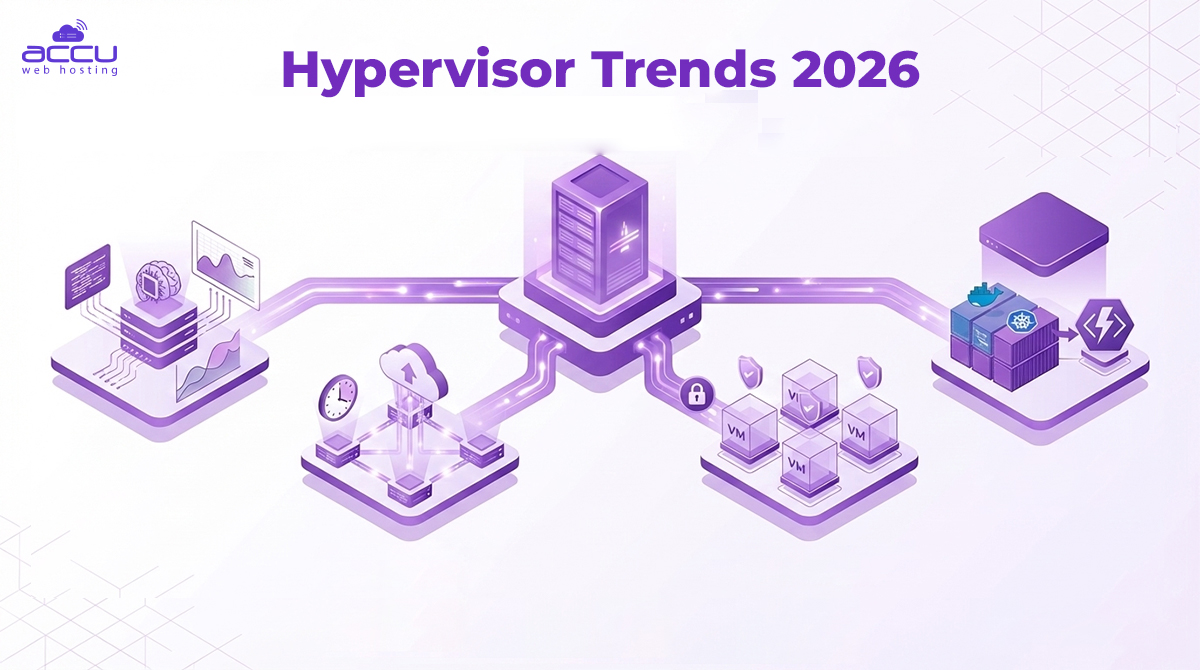
When you host a Virtual Private Server (VPS), you’re essentially renting a slice of a very powerful physical computer. But how does that one computer know how to split itself into dozens of smaller, private servers without getting confused?
That job belongs to the Hypervisor.
In 2026, the hypervisor isn't just a background technical detail. It is the engine that determines if your website stays fast during a traffic spike or if your data stays safe from hackers.
For businesses running applications, platforms, and client systems on virtual servers, understanding where hypervisors are heading is no longer optional. It directly affects uptime, scalability, and operational control.
What exactly is a Hypervisor?
A physical server can run multiple virtual servers at the same time. The hypervisor is the layer that makes this possible. It ensures each virtual server operates in its own secure and isolated environment, with dedicated access to system resources.
Most importantly, it prevents issues in one virtual server from affecting the others, helping maintain stability, performance, and security across the entire platform.
For professional work, we use Type 1 (Bare-Metal) hypervisors. These are installed directly onto the hardware. They don't have to "ask permission" from an underlying operating system to get things done, which makes them incredibly fast and secure.
Type 2 (hosted) – Runs on top of another system. Mainly used for testing and learning.
The Move Toward Open-Source: Why KVM and Proxmox Lead the Market
In 2026, the biggest trend in the industry is the widespread move toward open-source tools. For years, many organizations felt restricted by expensive, closed-source software. Now, hypervisors like KVM and Proxmox have become the preferred options because they offer complete flexibility.
- KVM: This is the core technology powering most modern Servers. Because it is open-source, a global community of developers is constantly working to make it faster and more secure.
- Proxmox: While KVM provides the power, Proxmox provides the management interface. It has become a choice for small businesses because it is highly adaptable and simplifies the process of managing complex server environments.
When your host utilizes open-source technology, you aren't paying for "brand name" licenses. You are paying for actual performance, and you avoid being locked into a single provider's ecosystem.
AccuWeb Hosting’s VPS plans run on open-source hypervisors(only pay for performance and not licenses), supporting secure isolation, stable performance, and reliable server environments.
Enterprise-Grade VPS Starts with the Right Hypervisor
In 2026, the difference between a standard VPS and a production-ready VPS often comes down to virtualization quality.
Why KVM and XEN matter for VPS users
- KVM delivers near bare-metal performance, making it ideal for high-traffic websites, databases, and business-critical applications.
- XEN is known for strong isolation and operational stability, widely used in environments where reliability is non-negotiable.
This is not a luxury feature - it’s a baseline requirement for professional VPS deployments.
Running important workloads on virtual servers?
Your hypervisor layer should support growth, not limit it.
With AccuWeb Hosting’s VPS powered by KVM and XEN, you get virtualization designed for real production use. Not just basic hosting.
Detailed Comparison: KVM vs. XEN vs. Proxmox
| Feature | KVM | XEN | Proxmox |
| Industry Standing | The "Gold Standard" for VPS. | The "Security Specialist." | The "Management Powerhouse." |
| Performance | High. Near-native speeds. | High, but setup is complex. | High (Uses KVM as the engine). |
| Operating Systems | Supports Linux, Windows, & BSD. | Supports Linux, Windows, & BSD. | Supports Linux & Windows. |
| Cost to Provider | $0 (Open Source). | $0 (Open Source). | $0 (Open Source / Optional Support). |
| Best For | Modern web apps & scaling. | Regulatory compliance. | High-touch managed services. |
Building a VPS environment for long-term use?
Choose a virtualization foundation that scales with your goals
KVM vs. XEN: Which One Is for You?
At AccuWeb Hosting, we use two industry leaders: KVM and XEN. You don't need deep tech. Knowledge to choose between them, it usually comes down to what you're building.
| Use cases | Suggested | Benefits |
| Running a high-traffic store or AI app | KVM | It’s built for speed. It talks to the server’s brain (the CPU) almost instantly. |
| Managing sensitive legal or health data | XEN | It’s built like a vault. It creates the strongest possible walls between users. |
| New to VPS and want something easy | KVM | It plays very well with almost every type of software and operating system. |
Not sure which virtualization setup fits your workload?
Start with a VPS environment that lets you grow confidently and manage systems with control.
The Decision: Which One Should You Trust?
- Choose a KVM Provider if you want the best balance of price and raw performance. It is the most tested technology in the world right now.
- Choose a Proxmox Provider if you want a great user interface and the ability to use lightweight containers for small tasks.
- Choose a XEN Provider if your industry has strict legal requirements for data isolation that specifically mention microkernel architecture.
A Closer Look at the Infrastructure
To understand how these technologies differ in action, we can look at three specific areas: Isolation, Resource Handling, and Growth.
1. Security and Isolation
While all three provide private environments, they handle the "walls" differently:
- KVM uses the Linux kernel itself to create a barrier. It is very hard to break, making it safe for almost any business use.
- XEN uses a "microkernel" design. This means the hypervisor is tiny and has a very small surface area for hackers to attack.
- Proxmox inherits KVM's security but adds a layer of firewall management that makes it easier for providers to protect your server from the dashboard.
2. Resource Handling (CPU & RAM)
In 2026, how a server handles its memory is a top priority:
- KVM is famous for "Virtio," which allows the virtual machine to talk to the hardware with almost zero delay.
- XEN excels in "Paravirtualization," a method where the guest OS knows it is virtualized and works with the hypervisor to be more efficient.
- Proxmox stands out by offering LXCs (Linux Containers) alongside standard virtual machines. This allows providers to offer ultra-lightweight servers that start in seconds.
3. Scaling and Flexibility
How easy is it to grow when your traffic spikes?
- KVM is the most flexible. Most modern automation tools are built for KVM first, meaning your provider can add RAM or CPU to your plan with a single click.
- Proxmox offers the best "Live Migration" tools. If a physical server needs maintenance, Proxmox can move your running VPS to a new machine without your website ever going offline.
Who Benefits Most from Modern Hypervisors?
Hypervisor innovation supports a wide range of VPS users:
- Businesses running customer-facing platforms
- Agencies managing multiple client systems
- Developers deploying production applications
- IT teams maintaining private environments
- Organizations focused on stability and compliance
The common need across all of them is clear:
Secure, Predictable, and Scalable virtual infrastructure.
3 Big Changes We’re Seeing in 2026

1. Smart Resource Sharing
A VPS does have isolated resources, but that isolation is controlled by the hypervisor. While each VPS is allocated its own CPU, memory, and storage limits, the underlying physical hardware is still shared. In 2026, modern hypervisors actively manage this shared environment by enforcing fair CPU scheduling, memory usage, and disk I/O limits in real time.
AI-Driven Infrastructure Management
AI is no longer a concept for the future; it is actively integrated into the hypervisor to help manage your server. We refer to this as Predictive Resource Management.
Think of it this way: instead of your server reacting after a crash occurs, the system uses data to predict potential issues. If the system detects a sudden surge in traffic, it can automatically allocate more power before your website or application experiences a slowdown. It essentially functions as a constant monitoring service, fine-tuning your VPS to ensure it operates at peak efficiency.
2. Security by Design
In 2026, hackers are more sophisticated, but so is our infrastructure. Modern hypervisors now use "Confidential Computing." This means your data is encrypted even while the server is actively working on it. It’s like having a shredder inside your locked office—no one sees the sensitive info, not even for a second.
Enhanced Data Protection with Confidential Computing
As the use of AI grows, so does the requirement for data privacy. Modern hypervisors have introduced a standard known as Confidential Computing. In the past, data was typically only encrypted while stored on the hard drive. However, while the system was actively processing that data, it was briefly accessible. Confidential Computing ensures that your information remains isolated even while it is being processed. For organizations handling sensitive customer data or proprietary models, this is the current standard for high-level security.
3. Eco-Friendly Power
We all care about our carbon footprint. Newer virtualization tech is much more efficient. By packing more "virtual" power into less "physical" hardware, we use less electricity and produce less heat, which is better for the planet and keeps your hosting costs predictable.
Final Thoughts
The most successful hosting providers are no longer just selling "space." They are selling optimized environments. By using open-source tools like these, they can invest more in their support teams and faster hardware (like NVMe storage) rather than paying for expensive software licenses.
With KVM and XEN at the core of its VPS offerings, AccuWeb Hosting delivers a foundation that aligns with modern infrastructure needs - reliable today, ready for tomorrow.
About the Author: Jason-Pat
Founder & CTO at AccuWebHosting.com. He shares his web hosting insights at AccuWebHosting blog. He mostly writes on the latest web hosting trends, WordPress, storage technologies, Windows and Linux hosting platforms.


