Domain Hacks: What They Are, Examples, and How to Create One

In today's digital world, having a solid online presence is very important for businesses and individuals. Using domain names creatively can help you stand out online and make a lasting impression. Whether you're new to this or already experienced, this guide will give you helpful advice on using domain hacking effectively this year.
Let's explore domain hacking to boost your online presence!
.com domains are by far the most popular. Out of the 359.3 million domain registrations in 2023, 160.8 million were .com domains. That’s over 44%!
If you need help finding a good .com domain, consider domain hacking. It's a creative way to get a unique domain without requiring a .com. If you need help finding the perfect domain for your website, domain hacking could be the answer.
- Approximately 45% of domain hacks use country-code top-level domains (ccTLDs) like .ly, .io, .me, and .it to create unique brand names (e.g., instagr.am).
- 35% of startups are said to consider using domain hacks for branding due to their uniqueness, availability, and SEO benefits.
- Some domain hacks are so clever that they act as punny or witty brand names, creating an instant connection with audiences.
- About 68% of users find domain hacks easier to remember than traditional domain names.
What Is a Domain Hack?

A domain hack is a domain name that combines the name before the extension with the domain extension to create a complete word or phrase.
For example:
- blo.gs creates the word “blogs”
- del.icio.us creates the word “delicious”
- love.me creates a short and memorable phrase
The term “domain hack” does not refer to hacking, cybercrime, or unauthorized access. It is simply a creative domain-naming method.
Domain hacks were created using country-code top-level domains, also called ccTLDs. Today, businesses can also use newer generic domain extensions to create brand-focused names.
A good domain hack should be easy to understand without requiring users to guess where the name ends and the extension begins.
How Does A Domain Hack Work?
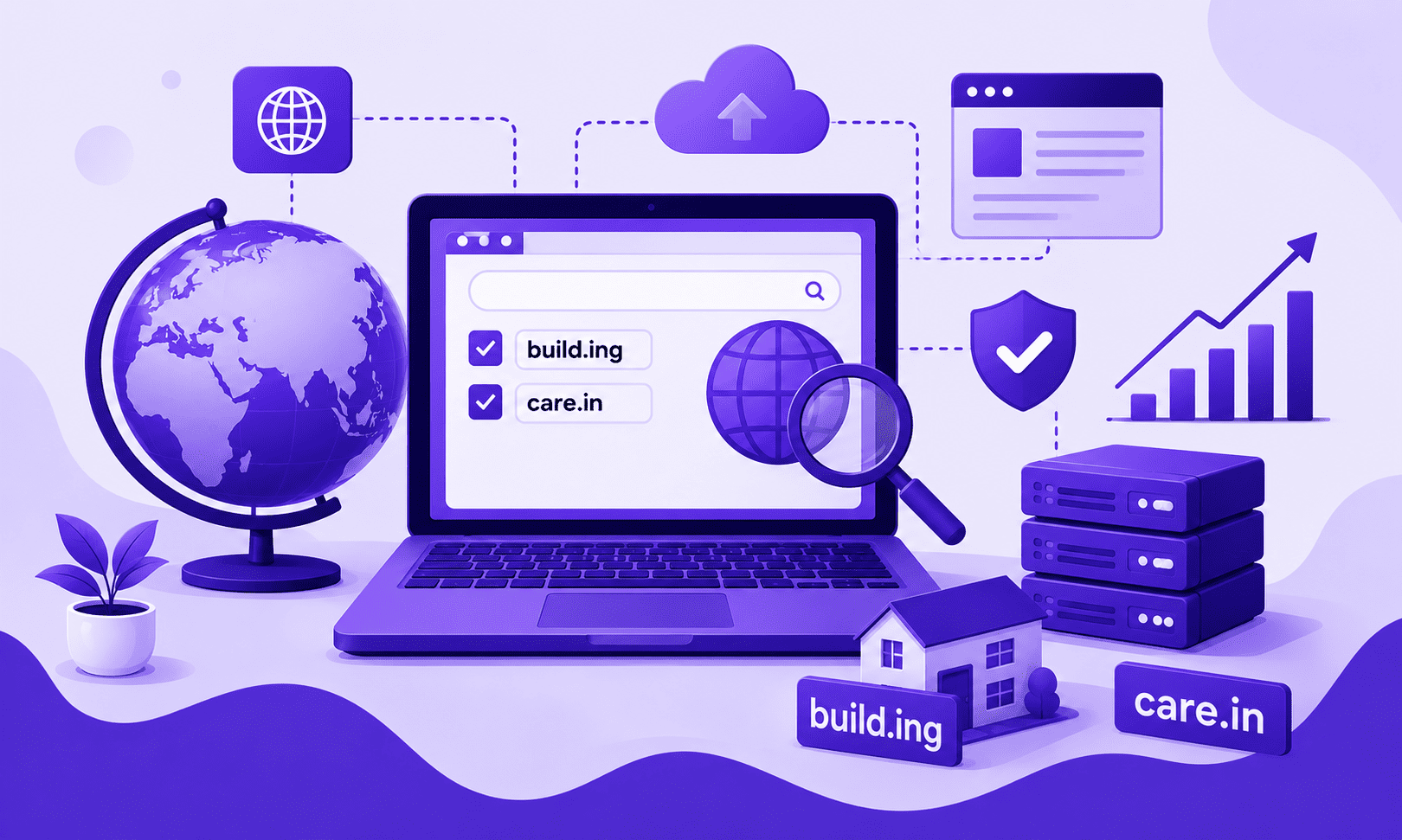
A domain hack works by using the domain extension as part of a word, brand name, or phrase.
For example:
care.in
The word “care” is placed before the .in extension. Together, the domain reads as “care in.”
Another example is:
build.ing
The word “build” combines with the .ing extension to create a complete word.
The extension does not always need to describe the business. However, the complete domain should still be clear and relevant to the brand.
Before registering a domain hack, check whether:
- The complete name is easy to read
- Users can pronounce it correctly
- Users can type it without confusion
- The extension is available
- The extension supports your intended use
- The registration rules meet your requirements
A creative domain is useful only when visitors can remember and access it easily.
Popular Domain Hack Examples
| Domain Hack | Complete Word or Phrase | Extension |
| blo.gs | Blogs | .gs |
| del.icio.us | Delicious | .us |
| love.me | Love me | .me |
| bit.ly | Bitly | .ly |
| youtu.be | YouTube | .be |
| spoti.fi | Spotify | .fi |
| care.in | Care in | .in |
| build.ing | Building | .ing |
Some examples may be used as shortened links or redirects rather than primary website domains.
Before copying a naming idea, check domain availability and avoid using names that may conflict with existing brands or trademarks.
A Brief History Of Domain Hacks:
Domain hacks became popular when website owners began using country-code domain extensions as part of words and brand names.
Some early examples included names such as inter.net and pla.net. The use of del.icio.us later made the concept more widely known.
As more domain extensions became available, businesses gained more options for creating short and brand-focused domain names. Today, domain hacks are used for startup names, marketing campaigns, shortened links, personal websites, and online products.
As of Sept. 30, 2023, the 10 largest TLDs by number of reported domain names were .com, .cn, .de, .net, .uk, .org, .nl, .ru, .br and .au.

Source: dnib.com
Are Domain Hacks a Good Choice?
A domain hack can be a good choice when it makes your brand easier to remember. However, it may not work well if users find the extension confusing or difficult to type.
The right choice depends on your audience, business type, brand name, and how you plan to use the domain.
A short and clear domain hack can support branding. A complicated domain hack may create confusion and cause users to enter the wrong address.
Benefits of Using a Domain Hack
Create a Short and Memorable Brand Name
A domain hack can help you create a short name when the matching .com domain is unavailable.
A simple and memorable domain may be easier to use in advertisements, social media posts, and marketing materials.
Find More Naming Options
Many short .com domains are already registered. Using a suitable extension can provide more naming choices.
This can help startups and new businesses find a domain that closely matches their brand.
Make Your Brand Stand Out
A creative domain can make a business name look different from traditional domain names.
The domain should still be easy to understand and should not make users guess how to spell it.
Support Marketing Campaigns
Domain hacks can be useful for short links, product launches, social media campaigns, and promotional pages.
A separate campaign domain can also make a long URL easier to share.
Limitations of Domain Hacks
Some Users May Find the Extension Confusing
Many users are familiar with .com, .org, and .net. A less common extension may be harder for some visitors to remember.
If users cannot understand the complete domain when they hear it, they may type the wrong address.
Country-Code Domains May Have Registration Rules
Some country-code extensions have eligibility requirements or local registration rules.
Always review the registry or registrar requirements before registering a country-code domain.
Domain Extensions Can Affect Geographic Expectations
Some country-code extensions may suggest that a website is intended for a specific country.
Google treats several commonly used extensions, such as .io, .co, and .me, as generic. However, many other country-code domains remain associated with a particular location.
Renewal Costs May Be Higher
Some domain extensions have higher registration or renewal prices than standard extensions.
Check both the first-year price and the renewal price before purchasing the domain.
A Domain Hack Does Not Provide an SEO Advantage by Itself
A creative extension does not automatically improve search rankings.
Search performance depends more on helpful content, website quality, technical SEO, page experience, links, and user relevance.
The Domain May Be Hard to Share Verbally
A domain can look clear when written but become confusing when spoken.
Before registering, say the domain aloud and ask another person to write it down. If they cannot spell it correctly, consider a simpler option.
How to Create a Domain Hack?
Choose a Domain Hack:
It's time to develop your unique website name, but where should you start? First, choose a word or phrase. If it's for your website, it might be your business name. Can you divide it into two parts easily? Do the last few letters match a website ending or make a word?
Here are some tips for picking the right website ending:
- Think about famous endings: .com, .net, and .org are common but might be harder to find available.
- Look at country endings: These are two letters long, and there are lots of them. Check if the last two letters of your phrase match a country code. Remember, some country codes have special rules, so check those out too.
- Explore new endings: New website endings have been popping up in recent years, like .academy, .catering, and .services. Since many are whole words, making a catchy website name with them is easy.
Here are some examples of popular website endings you could use:
- .me - Montenegro
- .co - Colombia
- .it - Italy
- .ly - Libya
- .in - India
- .es - Spain
- .io - British Indian Ocean Territory
- .to - the Kingdom of Tonga
- .us - the United States
- .at - Austria
- .be - Belgium
- .is - Iceland
- .so - Somalia
- .de - Germany
Register Your Domain:

How to Check Domain Availability
Use a domain search tool to check whether your preferred name is available.
You can search for:
- The exact domain name
- Alternative extensions
- Similar domain names
- Related brand names
For registration information, modern lookup systems increasingly use RDAP. ICANN began transitioning generic domain registration data services from WHOIS to RDAP in 2025.

After payment, you will own your domain for the specified period.
Tip: If you plan to create a website, web hosts like Accuweb Hosting offer a hosting plan with a free domain for 1 year.
How to Protect Your Domain Hack
After registering your domain, secure the registrar account and domain settings.
Follow these steps:
- Use a strong and unique account password
- Enable two-factor authentication
- Turn on domain lock if available
- Keep your contact information updated
- Enable renewal reminders
- Review DNS records regularly
- Avoid sharing account access
- Watch for phishing emails related to domain renewal
A creative domain can still be targeted by phishing, account theft, or unauthorized DNS changes. Domain security should be part of the registration process.
These steps can reduce the risk of unauthorized domain transfers and unexpected service interruptions.
How to Choose a Good Domain Hack
Use this checklist before registering:
| Question | What to Check |
| Is it easy to read? | The complete name should be understandable at first glance |
| Is it easy to pronounce? | Users should be able to say it naturally |
| Is it easy to type? | Avoid unusual spelling and unnecessary symbols |
| Is it relevant? | The name should connect with your brand |
| Is the extension suitable? | Check country rules and intended audience |
| Is the renewal price affordable? | Review the long-term cost |
| Is it legally safe? | Check for trademark conflicts |
| Does it work internationally? | Consider your target audience |
| Is the matching social handle available? | Consistent branding can be helpful |
Set up Domain Management:
Once you've registered your domain, you'll get access to some tools to manage it. These tools let you adjust your domain if you're using it for a website and tweak some settings.
Depending on what you're using your domain for, here's what you might want to do next:
Once everything's set up right, your domain is safe and all set for your website.
Conclusion
Domain hacks offer a creative way to build a short and memorable online identity. They can be useful when the matching .com domain is unavailable or when a unique extension creates a strong brand name.
However, creativity should not be the only factor. A good domain hack should be easy to read, pronounce, type, and understand. You should also review registration rules, renewal pricing, geographic meaning, and possible trademark conflicts.
Before registering a domain, test it with other people and check whether it fits your long-term branding plans. If the name is clear and practical, a domain hack can be a useful alternative to a traditional domain name.
Frequently Asked Questions
1. What is a domain hack?
A domain hack is a creative domain name that combines the name before the extension with the domain extension to form a complete word or phrase.
2. Is a domain hack related to hacking?
No. A domain hack is a branding and naming technique. It does not involve unauthorized access or cybercrime.
3. Are domain hacks good for SEO?
A domain hack does not provide a direct SEO advantage. Search rankings depend mainly on helpful content, website quality, technical SEO, relevance, and user experience.
4. Can I use a country-code domain for a global website?
Yes, but you should check the registration rules and understand how users may interpret the extension. Some country-code domains are treated as generic by Google, while others may indicate a specific geographic audience.
5. Are domain hacks expensive?
The cost depends on the extension and registrar. Some extensions are affordable, while others have higher registration or renewal prices.
6. Should I choose a domain hack instead of a .com domain?
A .com domain remains familiar to many users. A domain hack can be a good alternative if it is short, clear, relevant, and easy to remember.
7. Can I use a domain hack for a business website?
Yes. A business can use a domain hack as its primary domain, campaign domain, or shortened link. Check the extension’s requirements and make sure the name is easy for customers to understand.
About the Author: Jason-Pat
Founder & CTO at AccuWebHosting.com. He shares his web hosting insights at AccuWebHosting blog. He mostly writes on the latest web hosting trends, WordPress, storage technologies, Windows and Linux hosting platforms.