Value Area Trading: Understanding How Markets Decide “Fair Price”
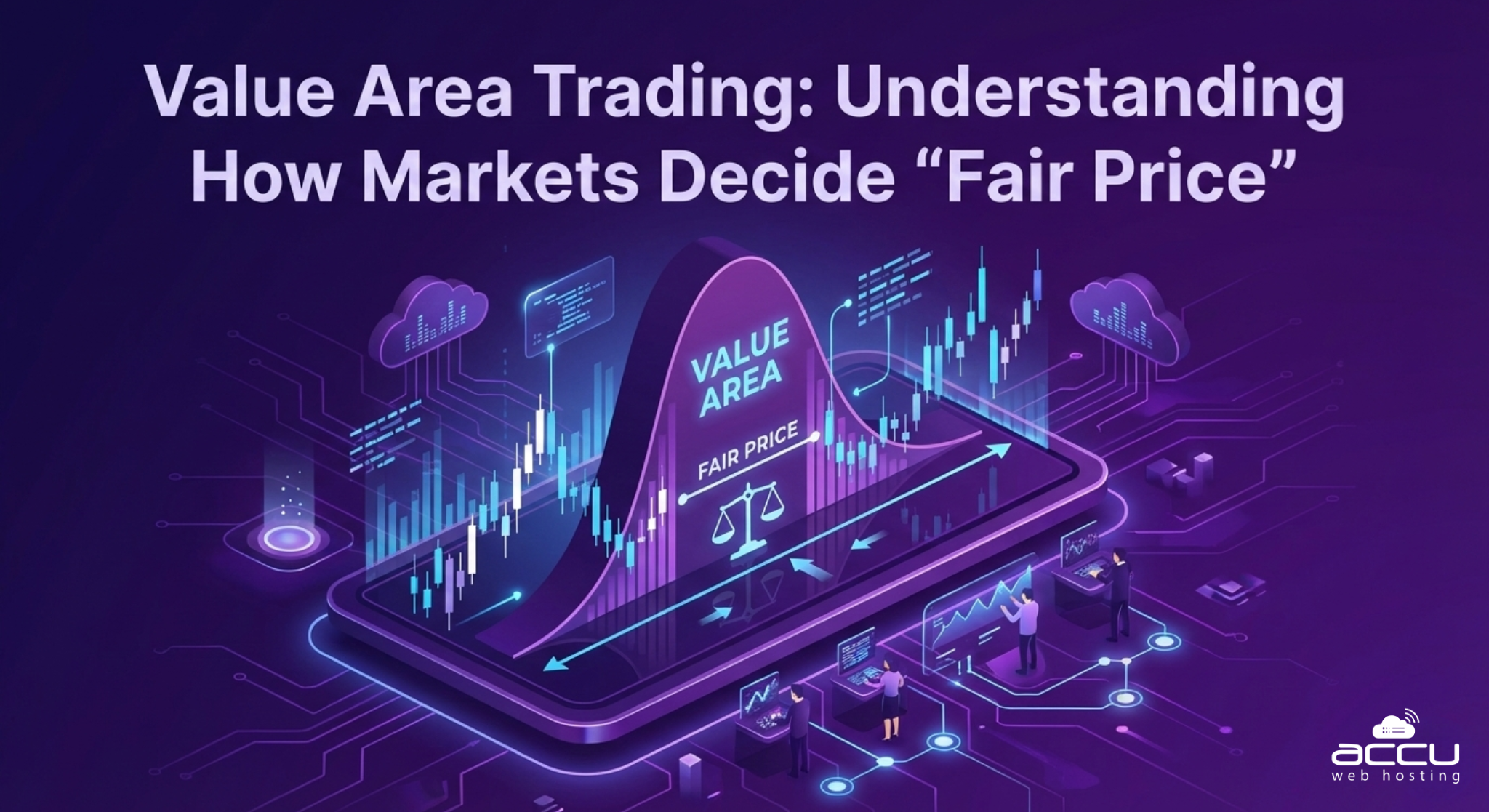
Before charts, indicators, or trading platforms enter the picture, markets can be understood in a very simple way: people gather around prices that feel reasonable.
Think about how we behave in daily life. If a coffee is priced fairly, people keep buying it. If it suddenly becomes too expensive, customers hesitate. If it’s unusually cheap, people rush in, but only until it stops feeling “normal.” Financial markets work in much the same way.
This idea of “normal” or “fair” pricing is the foundation of Value Area Trading.
Most people assume markets move because of news, indicators, or sudden emotion. In reality, price movement is largely driven by where participants are comfortable trading. Prices don’t wander endlessly; they pause, rotate, and spend time in specific zones.
These zones form what traders call the Value Area.
At its core, Value Area Trading is about identifying the price range where most transactions take place and using that information to understand market behavior.
What Traders Mean by “Value Area”
In trading terms, the Value Area is the price range that contains around 70% of total trading activity for a chosen time period.
Within this range:
- In a value area, the POC (Point of Control) sits at the centre. It represents the price level where the highest trading activity occurred.
- The upper edge of the value area marks the point where price begins to feel expensive and participation thins out.
- The lower edge marks where price starts to feel cheap, often attracting responsive buyers.
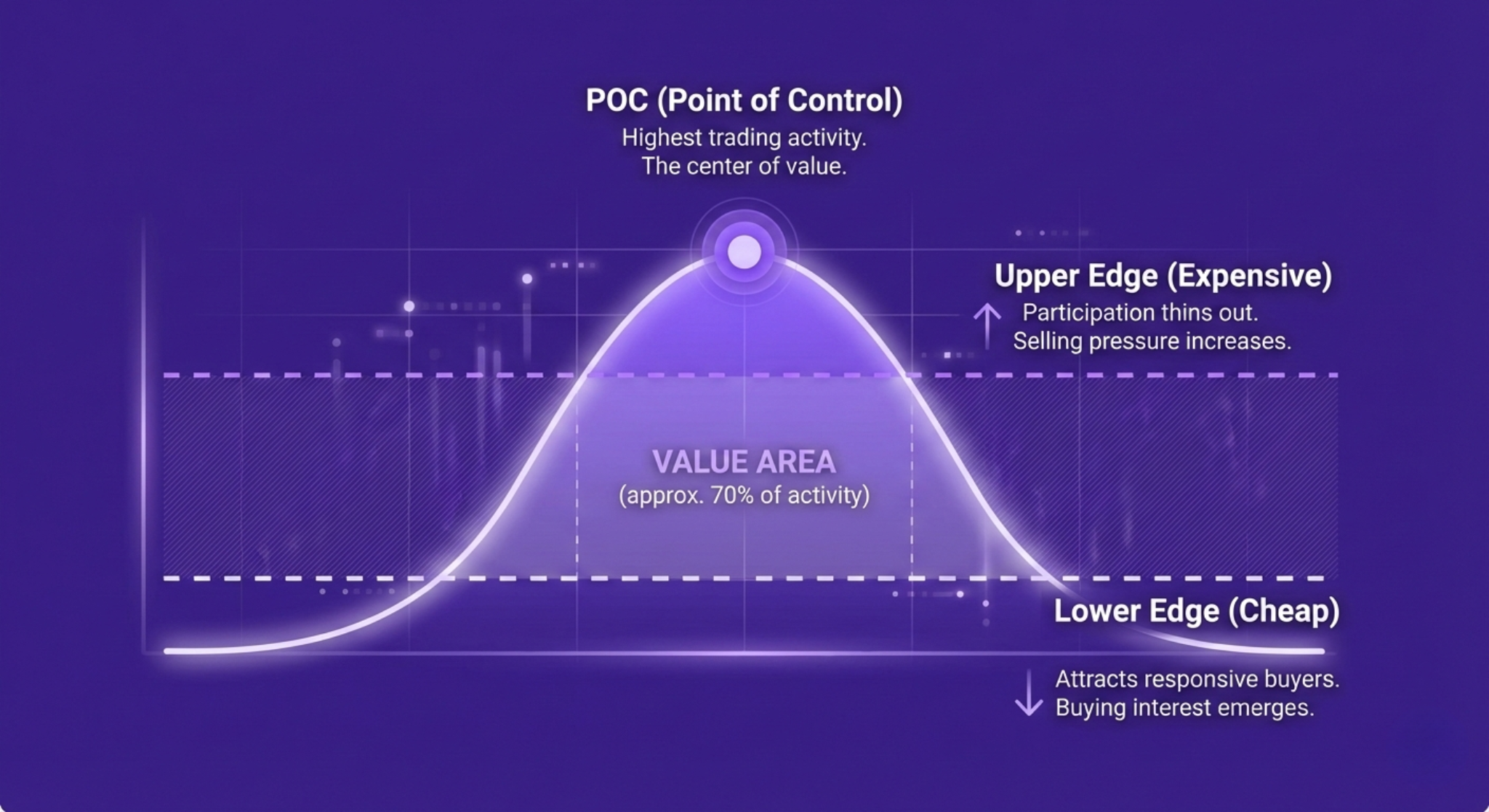
These levels are calculated using volume data, not guesswork. They reflect where real trades occurred, not where the price briefly passed through.
Value Area Trading depends on:
- Clean session opens
- Complete volume distribution
- No missing candles
When a platform disconnects, value calculations can reset or distort. Hosting the platform on a VPS avoids this issue by keeping the environment always-on.
✅ Ultra-Low Latency
How Price Naturally Organizes Itself
Before trading concepts enter the picture, think about price from a behavioral angle.
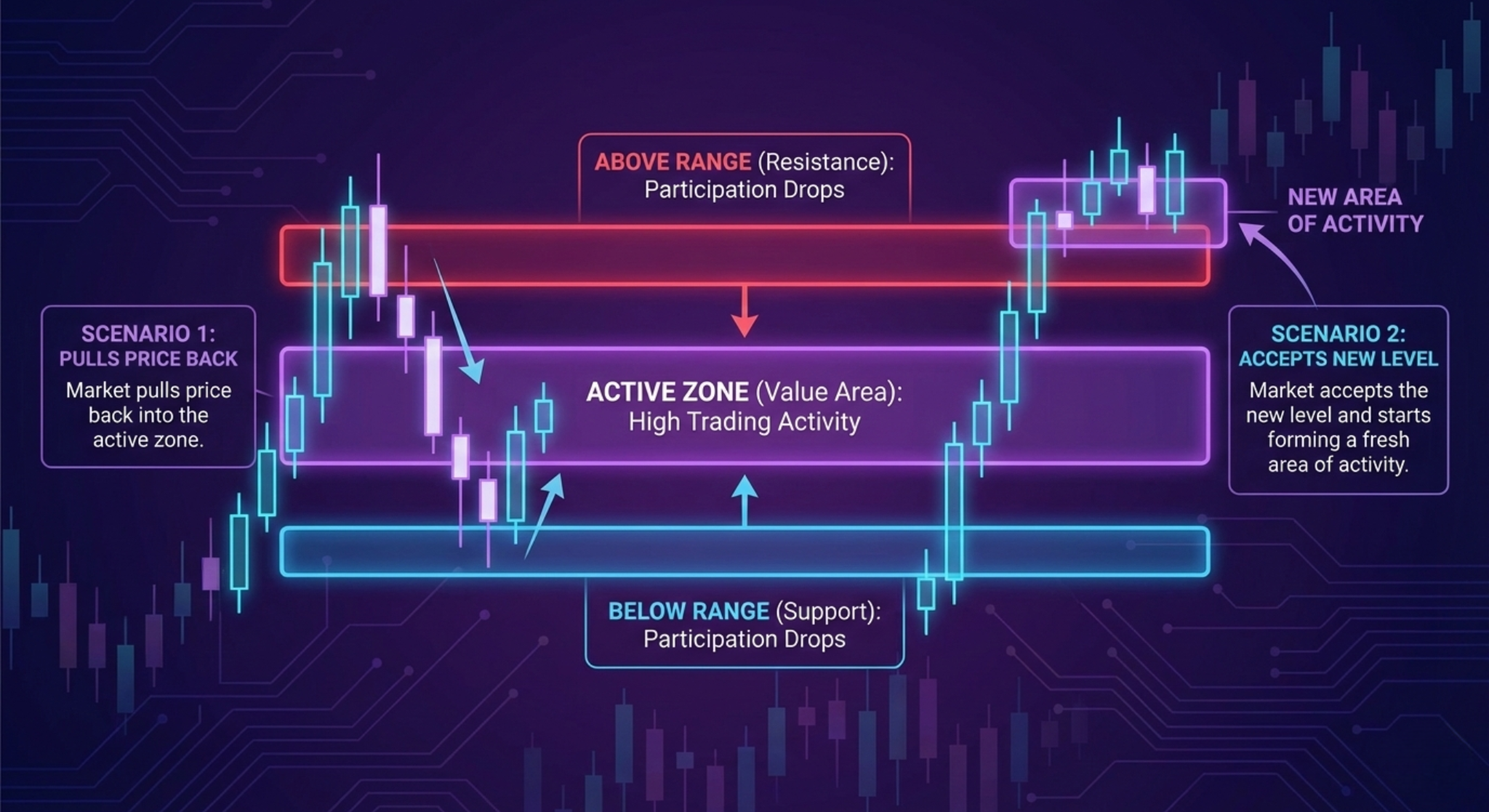
When a currency pair trades within a certain range for hours or days, it’s not accidental. Buyers and sellers are repeatedly agreeing that this range feels reasonable. Activity builds there, liquidity improves, and price keeps returning to it.
Move too far above that range and participation drops. Move too far below it, and the same thing happens. The market either:
- Pulls price back into the active zone, or
- Accepts the new level and starts forming a fresh area of activity
The Value Area simply maps this behavior.
How Traders Use Value Area in Practice
Value Area Trading isn’t about predicting direction. It’s about reading acceptance.
When price trades inside the value area, the market is balanced. Moves tend to slow down, rotate, and revisit familiar levels.
When price moves outside the value area, traders watch closely:
- If price returns quickly, the move was rejected
- If price stays outside and activity builds, the market is accepting a new price range
This approach helps traders decide whether to:
- Trade within a range
- Look for continuation
- Stay out and wait for clarity
A commonly used idea within this framework is that if price returns into a previous value area and holds there for a sustained period, it often explores the range more fully. This reflects hesitation rather than conviction.
Where Value Area Trading Works Best
Value Area Trading tends to perform well in:
- Sideways or consolidating markets
- Active sessions with consistent volume
- Markets where price revisits levels frequently
It is often used in:
- Forex
- Futures
- Index trading
The method scales across timeframes, from intraday charts to weekly analysis, as long as reliable volume data is available.
Value Area Trading Requires Both Strategy and Stable Execution
Setting Up Value Area Trading Using a Forex VPS from AccuWeb Hosting :
To use Value Area Trading effectively, execution speed and data stability matter - especially when trading live markets.
A Forex VPS helps by keeping your trading platform running continuously, without interruptions from local internet issues or power cuts.
Here’s how traders typically set it up using an AccuWeb Forex VPS:
1. Choose a VPS close to your broker’s servers
This reduces latency and ensures volume data and orders update faster.
2. Install your trading platform (MT4, MT5, or others)
The VPS runs the platform 24/7, even when your local system is offline.
3. Add volume profile or market profile tools
These tools calculate Value Area levels automatically for each session.
4. Keep sessions consistent
Using the same session timings daily ensures value areas remain reliable.
5. Monitor remotely
You can access the VPS from any device while your charts and data stay active in the background.
This setup is especially useful for traders who rely on session-based value areas or trade during specific market hours.
Limitations of Value Area Trading
Value Area Trading is not a universal solution, and understanding its limits matters.
- Strong trends can ignore value areas
In aggressive trends; price may move away from the previous value without returning. - High-impact news can distort volume
Economic releases can push prices through value zones without meaningful acceptance. - It depends on quality data
Poor or delayed volume data can lead to misleading levels. - It requires context, not automation alone
Treating value areas as fixed support or resistance often leads to false signals.
In short, Value Area Trading works best when combined with market awareness, not when followed mechanically.
Who Should Use Value Area Trading
This method suits traders who:
- Prefer structure over prediction
- Focus on market behavior rather than indicators
- Trade during active sessions
- Value, risk control, and clarity
It may not suit traders who rely solely on fast scalping or indicator-based systems without volume context.
Closing Thoughts
Value Area Trading is not about finding perfect entries. It’s about understanding where the market is comfortable and where it isn’t.
Once that distinction is clear, many price movements stop looking random. You begin to see structure, hesitation, acceptance, and rejection - all playing out around a small set of meaningful levels.
That clarity is what makes the method valuable, not complexity.
About the Author: Jason-Pat
Founder & CTO at AccuWebHosting.com. He shares his web hosting insights at AccuWebHosting blog. He mostly writes on the latest web hosting trends, WordPress, storage technologies, Windows and Linux hosting platforms.