Pricing Psychology for Hosting Resellers -What Makes Clients Actually Buy?
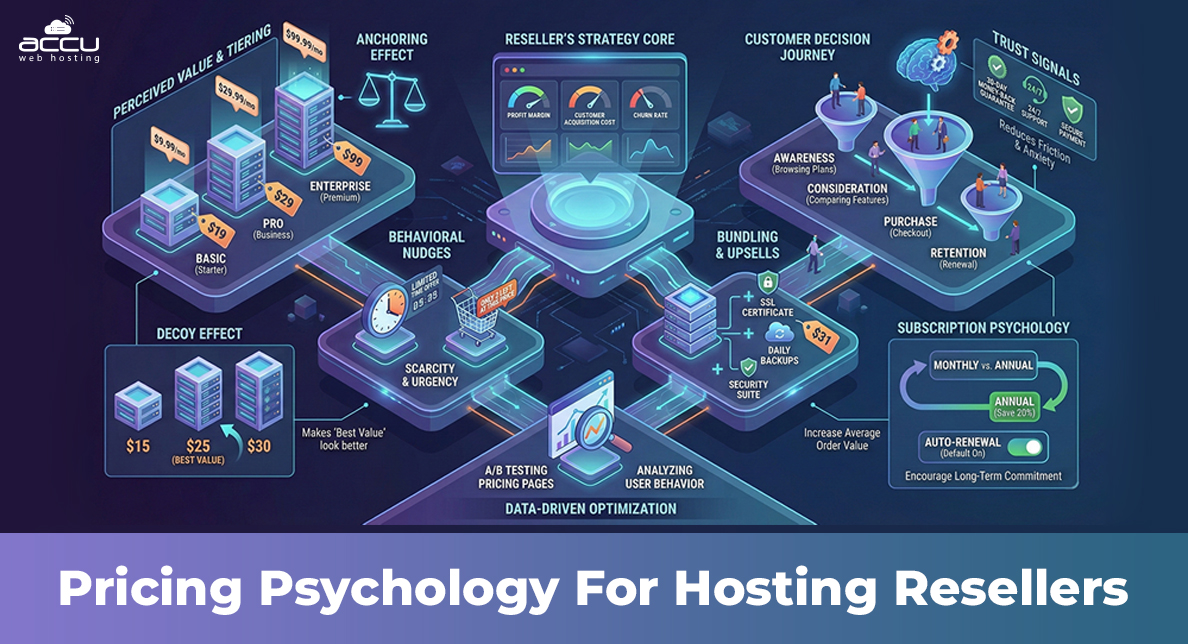
As a hosting reseller, you can have the fastest servers, 99.9% uptime guarantees, and 24/7 support, but if your pricing feels “off,” clients will scroll past you in seconds. I’ve seen resellers with weaker infrastructure out-earn everyone else simply because they understand one thing most don’t: people don’t buy hosting based on specs alone. They buy based on emotion, perception, and trust, and pricing is the #1 trigger that controls all three.
This is the hidden game of pricing psychology for hosting resellers.
Why do some clients happily pay $49/mo for a plan that costs you $8 to deliver, while others complain about your $15 package even when competitors charge $29 for less? It’s not about being the cheapest. It’s about price anchoring, rounded pricing, smart plan placement, limited-time offers, simple bundles, and many other easy-to-use psychological techniques that make your offers feel like a no-brainer.
What is Psychological Pricing in Reseller Hosting?
Psychological pricing in reseller hosting is the art of setting prices in a way that influences how clients perceive value and make buying decisions. It’s not just about the actual number you charge, it’s about how that number feels, compares to other plans, and signals trust or quality.
For example, a $40 hosting plan can feel more premium than a $50 plan if presented correctly, and a smartly added ‘extra’ plan can gently steer clients toward the plan you want them to pick.
Psychological pricing uses simple techniques like rounded vs. charm pricing, limited-time offers, and bundled services to guide buyers naturally toward the plan you want them to choose.
For hosting resellers, knowing these strategies can be the key to turning visitors into clients who confidently pick your plans.
Why Pricing Psychology Matters for Hosting Resellers?
If you’re a hosting reseller, you already know how to buy wholesale plans, spin up cPanel accounts, and set up white-label billing. Those are the basic steps. The next crucial part that decides whether you earn $8-$15 per client or $45-$90 per client is how you price what you sell.
Most resellers treat pricing like math: “I pay $8, so I charge $18 and make $10 profit.” That works… until someone else charges $14 and steals the sale. The moment you start competing only on dollars, you enter a race to the bottom that nobody wins long-term.
Pricing psychology changes the game completely. It’s the difference between clients seeing your service as “cheap hosting” and seeing it as “professional, reliable web hosting worth every penny.”
Here’s why it matters
- Buyers decide with emotion first, logic second. A visitor lands on your pricing page, glances at three plans, and within 6–8 seconds their brain has already decided which one “feels” right. Speed, disk space, and bandwidth barely catch attention. What catches attention is the story your prices tell: “Are you the budget option, the smart option, or the premium option?”
- Higher prices often attract more serious clients. Customers who pay $39–$69 per month tend to be more reliable: they open fewer support tickets, pay on time, stay subscribed for years, and even refer others. On the other hand, clients paying $5–$12 per month are usually more price-sensitive; they look for coupons, complain about small issues, and often leave as soon as they find a cheaper first-year deal.
- What clients feel your hosting is worth often matters more than what it actually costs. Two resellers can offer the same server, uptime, and support, but the one who presents their plans clearly, using smart price comparisons, attractive pricing, and obvious differences between plans, can charge 3–5× more and still make more sales. That’s because buyers perceive they are getting something better, even if the service is technically the same.
- You can’t out-spend the big brands on marketing, but you can out-think them on pricing. Companies like SiteGround, Kinsta, and WP Engine dominate partly because their pricing structures make customers feel smart and safe. Small resellers who copy the same psychological tactics (tiered plans, decoy options, bundling, badges like “Most Popular”) get the same trust effect without spending a cent on ads.
- The market has changed; $1 hosting is dead. After years of oversold “unlimited” plans crashing and companies disappearing overnight, serious business owners and agencies now run the other way when they see extremely cheap plans. They want stability and expertise;
Your technical setup gets you in the door. Your pricing psychology decides how much money you make once you’re there, and whether those clients stick around for years or vanish after twelve months.
Start Your Reseller Business With a Strong Foundation
If you're planning to use these pricing strategies, make sure your hosting platform is solid. AccuWeb Hosting gives you fast servers, stable performance, and 24/7 support; everything you need before you set your prices and attract clients with confidence.
How Customers Really Judge Hosting Prices?
When visitors land on a pricing page, they rarely evaluate your hosting plan like an engineer would. Very few buyers sit down and compare CPU, RAM, or bandwidth. Instead, most make a decision almost instantly, in 6–8 seconds, based on perception, trust, and how the pricing “feels.” This is why two resellers offering the same features can see drastically different sales numbers.
Clients judge prices based on value signals, not raw specs:
- Relative comparison: Buyers instinctively compare your plans to each other and to competitors. The way you structure and display your tiers can make one plan look like the obvious choice.
- Perceived benefits: Features like free backups, priority support, or included SSL certificates increase perceived value, even if the technical infrastructure is the same.
- Price presentation: Small changes, like $29 instead of $30, or positioning one plan as “recommended”- can shift client preference immediately.
- Emotional triggers: Scarcity (“only 10 spots left”), urgency (“offer ends today”), and bundling make buyers feel smart and in control of a good deal.
Price Anchoring
Making Every Plan Look More Valuable
Price anchoring is a simple but powerful strategy that helps clients see the value in the plan you want them to choose. Instead of showing just one or two options, you present a higher-priced plan first, which makes your mid-tier plan feel like a smart, affordable choice.
For example, if your plans are $15, $30, and $50, the $50 plan acts as the anchor; it makes the $30 plan seem like a better deal, even though it might cost you the same to deliver. This technique works because buyers rarely evaluate prices in isolation; they compare what’s in front of them.
For hosting resellers, using price anchoring can subtly guide clients toward higher-value packages, increase sales, and make your plans feel more premium without changing any underlying features.
Charm Pricing vs Rounded Pricing
Charm pricing (like $9.99 or $29.95) makes a plan look slightly cheaper because the eye focuses on the first number, while rounded pricing (like $10 or $30) feels cleaner and more premium.
Both work, but they trigger different reactions. Charm pricing is useful when you want your entry-level plans to look friendly and easy to choose. Rounded pricing works well when you want your hosting to appear stable, professional, and high-value, especially for business clients.
For hosting resellers, the best approach is to use charm pricing for lower tiers and rounded pricing for higher tiers, so customers feel your affordable plans are a good deal, and your premium plans carry more trust and seriousness. This simple shift can improve how clients judge your entire price structure.
The Decoy Plan Trick
Guide Clients Toward the Plan You Want Them to Choose
A decoy plan is an extra plan added mainly to influence the customer’s choice, not to be the main seller. When two plans are too close in price or features, buyers may feel unsure and hesitate. But when you introduce a third plan that is slightly overpriced or offers less value, it naturally pushes customers toward the plan you actually want them to pick.
For example, if you offer a $20 plan and a $35 plan, adding a $33 plan with fewer features makes the $35 plan look smarter and more worthwhile. Hosting resellers use this technique to reduce confusion, highlight the best option, and help clients choose with confidence.
The decoy plan works because people like comparing options, and often select the one that feels clearly better for just a little extra.
Plan Naming Psychology
How Your Labels Shape Buying Decisions
The names you give your hosting plans can influence how customers judge their value before they even look at the features. Simple labels like “Basic,” “Standard,” and “Premium” help buyers quickly understand which plan is meant for beginners and which one is built for heavier use.
But names can also guide customers toward the plan you want them to choose. For example, calling a mid-tier plan “Most Popular” or “Business” signals trust and makes it feel like the safe, recommended choice.
Avoid confusing or technical names, because they slow down decision-making. Clear, friendly labels create confidence and help clients feel they are picking the right plan without overthinking.
Turn These Pricing Strategies Into Real Sales
Great pricing only works when your hosting platform supports it. With AccuWeb Hosting, you can confidently sell plans with predictable performance, free SSL, easy account management, and a fully white-label setup.
Practical Pricing Checklist for Hosting Resellers
1. Price Anchoring
- Show a higher-priced plan first to make your mid-tier plan seem like a great deal.
- Example: $50 (anchor) vs. $30 (standard) vs. $15 (budget).
2. Bundle for Value
- Combine services (e.g., domain, SSL, backups) in packages to increase perceived value.
- Example: Bundle 1 Website + SSL + Backup for $29.99/month.
3. Charm Pricing
- Use $X.99 or $X.95 to make your plans feel more affordable.
- Example: $9.99 instead of $10.
4. Decoy Plan
- Add a higher-priced or less attractive plan to push customers toward the one you want them to choose.
- Example: $20 (basic), $33 (decoy), $35 (recommended).
5. Urgency with Time-Limited Offers
- Encourage action by offering discounts or deals with expiration dates.
- Example: "Get 30% off if you sign up in the next 24 hours!"
6. Free Trials
- Let customers test the service risk-free to increase the likelihood of conversion.
- Example: 7-day or 30-day free trial.
7. Tiered Pricing with Clear Labels
- Label your plans clearly (e.g., Basic, Business, Premium) to guide customers naturally.
- Example: “Most Popular” plan for mid-tier options.
8. Rounded Pricing for Premium Plans
- Use rounded pricing for higher-tier plans to signal quality and stability.
- Example: $30 instead of $29.99 for business plans.
9. Use Social Proof
- Display customer testimonials, reviews, or trust badges to build confidence.
- Example: "Used by 5,000+ agencies worldwide."
10. Create a “Best Value” Highlight
- Highlight the plan you want customers to choose as “Best Value” or “Most Popular.”
- Example: “Most Popular Plan” highlighted in bold.
Conclusion
Smart pricing isn’t about lowering numbers; it’s about shaping how customers perceive value, trust, and professionalism. When you apply strategies like anchoring, clear tiers, and simple bundles, clients feel confident in their choice. And that confidence starts with a truly invisible, professional white-label infrastructure like the one AccuWeb Hosting provides. With the right foundation, your pricing turns visitors into long-term clients.
About the Author: Jason-Pat
Founder & CTO at AccuWebHosting.com. He shares his web hosting insights at AccuWebHosting blog. He mostly writes on the latest web hosting trends, WordPress, storage technologies, Windows and Linux hosting platforms.