Web Hosting Adoption Trends in APAC, EMEA & North America – 2026 Report
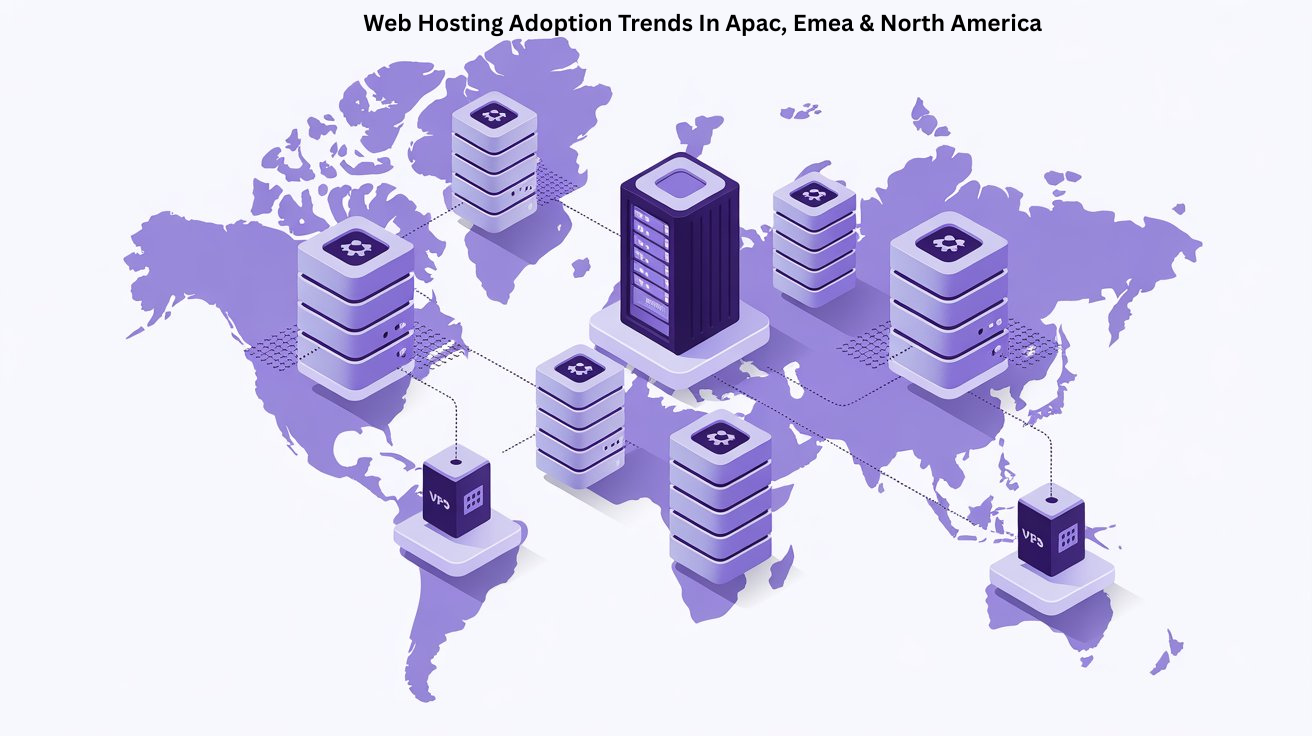
Web hosting adoption is no longer a one-size-fits-all decision. Businesses and developers across different regions choose hosting solutions based on local market conditions, infrastructure availability, regulatory requirements, and performance expectations. What works in one region may not be the right fit in another.
Across APAC, EMEA, and North America, hosting trends are influenced by a wide range of factors, from rapid digital growth and cost sensitivity to strict data protection laws and mature cloud ecosystems. These differences play a key role in how organizations evaluate options such as shared hosting, cloud platforms, and managed WP hosting.
This article explores how web hosting adoption varies across APAC, EMEA, and North America, highlighting key trends, preferences, and challenges that influence how organizations choose and use hosting services today.
Global Web Hosting Market in 2026: Size, Growth, and Regional Shares
The web hosting industry continues to grow strongly in 2026, driven by ongoing digital transformation, rising cloud adoption, and increasing demand for online services. Industry forecasts estimate that the global web hosting services market will be valued around USD 152.8 billion in 2026, up from about USD 129.5 billion in 2025. This growth reflects broad adoption across businesses of all sizes and increased reliance on hosted infrastructure worldwide.
North America: The Leading Region
North America remains the largest regional contributor to the web hosting market in 2026. Various reports for 2025 and 2026 estimate North America’s share to be closer to 39% to 41.25% of the global market, reflecting continued digital adoption and the strong presence of major hosting and cloud service providers.
The United States, in particular, plays a dominant role in this regional leadership, supported by high internet penetration, extensive cloud infrastructure, and enterprise demand for scalable hosting solutions. While exact 2026 regional revenue figures vary by source, North America’s share underscores its continued strength in hosting adoption and infrastructure capacity.
Asia-Pacific (APAC): Fast Growth Driven by Digital Expansion
The APAC region is one of the fastest-growing markets for web hosting services. Countries like India, China, and Japan are expanding hosting adoption rapidly as businesses and online platforms proliferate. This region is projected to maintain a strong growth trajectory beyond 2026, supported by increasing internet penetration, mobile traffic, and e-commerce adoption.
APAC’s growth isn’t limited to sheer website counts; demand for cloud, VPS, and managed hosting is also rising as startups and SMEs prioritize scalable, performance-oriented infrastructure.
EMEA: Stable Adoption with Compliance Focus
Europe, the Middle East, and Africa (EMEA) show diverse hosting adoption patterns in 2026. Europe continues to capture a significant share owing to strong tech infrastructure and regulatory drivers like GDPR that influence data-local hosting choices. Meanwhile, the Middle East and Africa are experiencing steady digital growth as governments and private sectors invest in smart cities and digital ecosystems.
Although exact 2026 numbers aren’t always published publicly, most market analyses point to EMEA maintaining a substantial portion of the global web hosting market, supported by strong enterprise use, cloud adoption, and cross-border business hosting needs.
Infrastructure That Adapts to Your Region
Different regions demand different hosting strengths, from low latency and scalable cloud infrastructure to strict compliance and predictable performance. Our hosting platform is designed to meet these regional needs with global data centers, flexible plans, and infrastructure-level security that adapts as your business grows.
Key Factors Driving Hosting Choices Worldwide
In 2026, web hosting decisions aren’t just about price; they are shaped by infrastructure maturity, technology needs, digital transformation goals, and regional economic dynamics. Across APAC, EMEA, and North America, several common drivers influence how businesses choose hosting services and how providers adapt to demand.
1. Cloud Adoption and Digital Transformation
Cloud-based hosting continues to be a central theme in how companies build and scale digital services. Businesses increasingly prefer cloud environments for their flexibility, scalability, and integration with modern tools and workflows. This trend is reflected in the broader hosting market’s growth projections, which show strong adoption of cloud and hybrid infrastructure worldwide. Cloud hosting is especially attractive for companies that need on-demand resource scaling without upfront hardware investments.
2. Enterprise Demand and Compliance Requirements
Regulatory and compliance concerns drive different hosting choices across regions. In EMEA, strong data protection standards like GDPR push companies toward hosting solutions that offer data locality and compliance guarantees. Meanwhile, in North America, enterprises often demand managed and cloud hosting that supports advanced security, performance SLAs, and integration with enterprise software stacks.
3. Performance, Latency, and Infrastructure Footprint
Hosting priorities vary by geography. In North America, robust data center infrastructure and high internet penetration mean companies expect low latency and high performance for both desktop and mobile visitors. In APAC, rapid digital adoption in markets like India and China is increasing demand for local data centers to reduce latency and comply with regional data laws. Strategic hubs like Singapore are becoming connectivity centers for Southeast Asia’s growing online economy.
4. SME and Startup Growth Driving Adoption
Small and medium enterprises (SMEs), startups, and digital agencies are major drivers of web hosting demand globally. In APAC, this segment is a significant growth engine as more small businesses go online and require affordable, scalable hosting plans, especially VPS and cloud options. This trend aligns with a broader global shift toward digital commerce and online services.
5. Security and Performance Expectations
Security remains a top priority for organizations of all sizes. In 2025, a large majority of hosting providers reported implementing new security measures to counter rising threats like malware, DDoS attacks, and vulnerabilities in popular platforms. Clients increasingly expect integrated protection and performance guarantees, pushing hosts to build stronger infrastructure defenses rather than relying on plugins or add-on tools alone.
6. Emerging Technologies and Hosting Innovation
Hosting services are evolving with new technologies like AI-powered management, edge computing, and serverless architectures. AI tools are being used for automated performance optimization, security monitoring, and intelligent support, making hosting more responsive and easier to manage for non-technical users. Edge computing investments help handle latency-sensitive applications, especially in gaming, streaming, and IoT use cases.
Shared Hosting vs VPS vs Cloud: Regional Preferences
Different regions show distinct preferences when it comes to hosting types—shaped by digital maturity, budget priorities, regulatory requirements, and performance needs.
Shared Hosting: Everywhere for Entry-Level Sites
Shared hosting remains highly popular globally because of its low cost and simplicity, especially among small businesses and beginner websites. It accounts for a large portion of total hosting offerings and adoption worldwide, often chosen by individuals and small enterprises with modest traffic or limited technical requirements. Shared hosting’s affordability and fully managed nature make it a natural first choice in regions with many small and micro businesses across APAC, EMEA, and North America.
North America: VPS & Cloud for Performance and Flexibility
In North America, businesses increasingly prefer VPS and cloud hosting over shared plans due to performance, security, and scalability. The region’s advanced infrastructure and high digital sophistication encourage enterprises, e-commerce platforms, and tech startups to choose VPS for dedicated virtual environments and cloud hosting for elastic scaling, global distribution, and high availability. North America’s mature market supports both hybrid and multi-cloud strategies, reflecting strong demand for performance-oriented and enterprise-grade hosting solutions.
APAC: Rapid Growth in VPS and Cloud
Asia-Pacific (APAC) is experiencing fast adoption of VPS and cloud hosting, driven by booming e-commerce, digital services, and mobile usage. Countries like China, India, and Japan increasingly use VPS to balance cost and control, while cloud hosting grows rapidly for its scalability and pay-as-you-go flexibility. APAC’s large population and expanding startup ecosystem mean that many emerging businesses start with shared hosting but quickly scale into VPS or cloud as traffic grows and performance needs increase.
EMEA: Hybrid Needs and Compliance
In the Europe, Middle East & Africa (EMEA) region, VPS and cloud adoption are boosted by enterprises seeking scalable hosting that meets security and data residency requirements. European organizations often prefer VPS for control and compliance, while cloud hosting attracts businesses needing robust uptime and flexible resource expansion.
In parts of the Middle East & Africa, a growing number of companies are moving into VPS and cloud environments as local digital economies expand.
Choose the Hosting That Fits Your Growth Path
Whether you’re starting with shared hosting, upgrading to VPS, or scaling with cloud infrastructure, choosing the right hosting matters at every stage. Our hosting solutions let you start small, scale smoothly, and stay compliant, without forced migrations or performance trade-offs.
Security, Compliance, and Privacy Expectations by Region
When choosing web hosting services, organizations across regions are influenced by different security, compliance, and privacy priorities — shaped by local laws, customer trust expectations, and evolving regulatory environments.
Europe: Strong Privacy Laws and Data Protection
In Europe, privacy expectations are among the highest in the world, driven by the General Data Protection Regulation (GDPR). GDPR requires strict controls on how personal data is collected, processed, and stored, and imposes heavy penalties for non-compliance. European organizations often demand hosting providers with explicit data protection guarantees, localized data centers, and transparency in data practices to satisfy both legal and customer expectations. Certification schemes like the Europrivacy seal further help companies demonstrate compliance with GDPR standards.
Expectations in Europe include:
- Strong consent and data processing transparency
- Data residency within the EU/EEA
- External compliance frameworks (e.g., GDPR, EU Cloud Code of Conduct)
North America: Security Meets Practical Regulation
In North America, security and compliance focus strongly on sector-specific requirements rather than a single unifying federal privacy law. U.S. regulations such as HIPAA (for healthcare) and CCPA/CPRA (California privacy rules) shape how businesses think about data protection, especially for sensitive or regulated industries like finance and health. Canadian laws like PIPEDA also influence privacy practices, often requiring companies to host or control encryption keys in-region to satisfy legal obligations.
Expectations in North America include:
- Demonstrable encryption and access controls
- Compliance with state and federal privacy frameworks
- Practical, audit-ready security for regulated data flows
APAC: Rapidly Evolving Privacy and Local Compliance
The Asia-Pacific region is diverse, with countries like Japan, South Korea, Singapore, India, Australia, and others implementing contemporary privacy laws. While some regions emphasize identity protection and auditability, others introduce requirements for data minimization and timely breach reporting. Rapid digital growth and cloud adoption mean companies here often balance privacy expectations with scalability needs. Countries are also increasingly adopting data governance frameworks that embed privacy into business operations rather than treating protection as an afterthought.
Expectations in APAC include:
- Emerging local privacy laws (PDPA, DPDP Act, etc.)
- Data governance and identity security emphasis
- Compliance documentation and audit preparedness
Pricing Models and Cost Sensitivity Across Markets
Pricing is one of the most important factors that influence how individuals and businesses choose web hosting, and it varies significantly across regions depending on economic context, digital maturity, and infrastructure availability.
Different Hosting Pricing Models
Web hosting services typically follow three major pricing models:
- Fixed Plans: Common with shared and traditional VPS hosting, where customers pay a set monthly or yearly fee based on allocated resources (CPU, RAM, storage). This model is predictable and simple, making it attractive for small businesses and entry-level sites.
- Pay-As-You-Go: Used predominantly with cloud hosting platforms, where costs scale with actual usage such as compute time, storage, and data transfer. This model benefits businesses with variable workloads or apps that experience fluctuating traffic.
- Hybrid or Tiered Pricing: Many hosting providers offer tiered plans that bundle features, resources, and management levels, giving customers choices that balance cost with performance needs.
| Region | Price Sensitivity | Popular Model | Key Preference |
| North America | Moderate | VPS & Cloud | Stability & performance |
| APAC | High | Shared, VPS/Cloud | Budget & scalability |
| Europe/EMEA | Mixed | Shared, VPS, Cloud | Compliance + value |
Where Web Hosting Is Headed Globally?: Future Outlook
The web hosting landscape is set for major evolution through 2026 and beyond, driven by advancing technology, shifting business needs, and changing user expectations. What was once a simple choice between shared and VPS is now a complex ecosystem that blends performance, security, flexibility, and global reach.
1. Growth of Cloud & Hybrid Hosting
Cloud hosting will continue to dominate the market as businesses seek elastic scalability, high availability, and pay-as-you-go pricing. Hybrid models that combine on-premises servers with public cloud infrastructure will be popular among enterprises that want both control and flexibility.
- Cloud hosting spend continues to grow as more companies migrate workloads from traditional servers.
- Hybrid solutions help organizations balance performance, compliance, and cost.
2. Edge Computing & Global Data Distribution
As user expectations for instant load times rise, hosting providers are investing in edge computing and distributed infrastructure.
- Static and dynamic content will be served closer to users.
- This minimizes latency and improves perceived performance worldwide, especially in regions where internet quality varies.
3. Built-In Security & Zero-Trust Hosting
Security expectations are shifting from add-on features to built-in fundamentals. Zero-trust principles, automatic threat detection, and infrastructure-level filtering are becoming essential parts of hosting platforms, not just optional plugins.
- Hosting providers are integrating firewalls, DDoS protection, and automated monitoring directly into server architectures.
- This reduces the need for heavy plugins that tax performance.
4. AI-Powered Hosting Tools
AI will increasingly shape how hosting is managed and optimized:
- Predictive scaling based on traffic patterns
- Automated optimization for speed & caching
- AI-assisted diagnostics and support
This helps even non-technical users maintain fast, secure, and reliable sites with less manual effort.
5. Sustainability & Green Hosting
Environmental concerns are reshaping infrastructure decisions:
- More providers are committing to renewable energy data centers
- Carbon footprint reporting and sustainable resource allocation will become selling points
Businesses with strong sustainability goals will look for hosting partners that align with their values.
6. Vertical & Industry-Specific Hosting
As applications become more specialized:
- E-commerce, gaming, and enterprise hosting solutions will be tailored with built-in tools (e.g., server scaling, caching layers, high throughput)
- Developers will look for hosting platforms that understand the demands of their industry
Conclusion: Choosing the Right Hosting for Your Region
Web hosting success depends on how well the infrastructure fits its environment. Traffic patterns, regulatory pressure, internet maturity, and user expectations all shape how hosting performs in real-world conditions. A setup that works perfectly in one region may struggle in another.
The most effective hosting strategies focus on regional alignment, placing workloads closer to users, selecting plans that match local cost sensitivity, and ensuring compliance where it matters. Businesses that plan for growth, rather than reacting to limits, gain stability and avoid disruptive migrations later.
As hosting technologies continue to evolve, flexibility becomes just as important as performance. Providers that offer scalable resources, regional data center coverage, and built-in security allow sites to adapt smoothly as demand changes.
In the end, the right hosting choice is one that supports your audience, your operations, and your future expansion, wherever your users are located.
About the Author: Jason-Pat
Founder & CTO at AccuWebHosting.com. He shares his web hosting insights at AccuWebHosting blog. He mostly writes on the latest web hosting trends, WordPress, storage technologies, Windows and Linux hosting platforms.