Best Web Hosting Services for Small Businesses in 2026

You've just set up a blueprint for your small business, sketched out your brand's story, and are now ready to break online. Launching a website is exciting, but at this stage things get tough that is, selecting the best web hosting. With thousands of providers and plans, the choices are just too numerous. Here's the thing: selecting the right web hosting provider is one of the most significant decisions you'll make.
The market is estimated to reach around $321.5 billion in 2026, up from $102 billion in 2020. That shift reflects rising demand for online visibility and competing with hundreds of thousands of other sites for attention, which calls for a speedy, secure, and dependable hosting solution.
To make your decision easier, we've narrowed it down to the web hosting platforms best suited for small businesses. Whether you're starting an e-commerce store or a portfolio site, choosing carefully ensures your site runs smoothly, loads quickly, and supports your business growth.
For most small businesses, AccuWeb Hosting offers the strongest overall mix of affordability, uptime, and support, starting at $2.99/month with free SSL, daily backups, and a 99.9% uptime guarantee. If you specifically need built-in AI website-building tools.
A Quick Overview
- Approximately 59% of small businesses use shared hosting for their websites, finding it affordable and reliable for their online presence.
- Nearly 90% of web hosting services now offer integrated website builders, making them ideal for non-tech-savvy users.
- Cyberattacks frequently target small businesses, highlighting the importance of SSL certificates and firewall protection in hosting plans.
- About 70% of small business websites experience a traffic boost when switching to faster, optimized web hosting with low latency.
Which Type of Hosting Does Your Small Business Actually Need?
| Hosting Type | What It Is | Best For |
| Shared Hosting | Your site shares server resources with other websites. Cheapest and simplest option. | New sites, blogs, and businesses expecting growth. |
| VPS Hosting | A virtually partitioned slice of a server, with dedicated resources. | Growing sites that have outgrown shared hosting but don't need a full server. |
| Cloud Hosting | Uses a network of virtual servers instead of one physical machine. Scales on demand. | Sites with unpredictable or spiking traffic (seasonal sales, campaigns). |
| Dedicated Hosting | An entire physical server just for your site. Most expensive, most control. | High-traffic e-commerce or businesses with strict compliance/data needs |
If you're just getting started, shared hosting is almost always the right call; it's affordable, easy to set up, and sufficient for the traffic most small business sites see in their first year or two. You can upgrade later without much hassle if a provider offers a clear scaling path.
Web Hosting Providers For Small Businesses in 2026
1. AccuWeb Hosting

AccuWeb Hosting offers secure, affordable hosting solutions for beginners, small businesses, and large enterprises, and covers shared, WordPress, Windows, VPS, reseller, and dedicated hosting. So it's a strong choice for resellers and agencies with specific needs.
Price starts at: $1.99 ( Cheap web hosting )
Best for: Small to medium businesses, growing e-commerce stores, and users who want flexible server environments (Linux & Windows) without paying enterprise prices.
Core Features & Infrastructure:
- Exceptional configuration flexibility, allowing users to choose between Linux and Windows platforms across multiple tiers.
- Generous baseline resource allocation including free SSL certificates, daily automated backups, free website migration handled by an expert team, and a free domain registration on signup.
- Robust security features built natively into shared nodes, including ConfigServer Security & Firewall (CSF), automated malware scanning, DDoS protection, and RAID-redundant architecture.
- 24/7 responsive customer support via live chat, ticketing, and phone assistance with no hidden setup fees.
2. Hostinger

Hostinger is consistently ranked as a top overall pick across independent reviews in 2026, built on a custom hPanel control panel, LiteSpeed servers, and a built-in AI website builder.
Price starts at: $2.99/month (promotional rate requiring long-term commitment; renews at $10.99+/mo)
Best for: New entrepreneurs, portfolio sites, and non-tech-savvy users looking for an intuitive setup experience.
Core Features & Infrastructure:
- Powered by LiteSpeed Enterprise web servers and optimized caching stacks, delivering fast initial page load speeds.
- Features a proprietary custom control panel (hPanel) designed to simplify file management, databases, and WordPress staging compared to traditional cPanel.
- Includes an integrated AI website builder that generates structured layouts and copy from plain text prompts.
- Free domain name and SSL certificate bundled with annual or multi-year billing tiers.
3. HostGator

HostGator's shared hosting lineup is built around familiar cPanel management and a clear, gradual upgrade path as your site grows.
Price starts at: $3.75/month
Best for: Traditional small business sites that prefer standard cPanel management and straightforward setup paths.
Core Features & Infrastructure:
- Reliable 99.9% uptime guarantee backed by fully redundant network routing.
- Standard inclusions consist of unmetered bandwidth, a free SSL certificate, and a free domain for the first year.
- Straightforward application installers for quick WordPress integration.
4. Bluehost
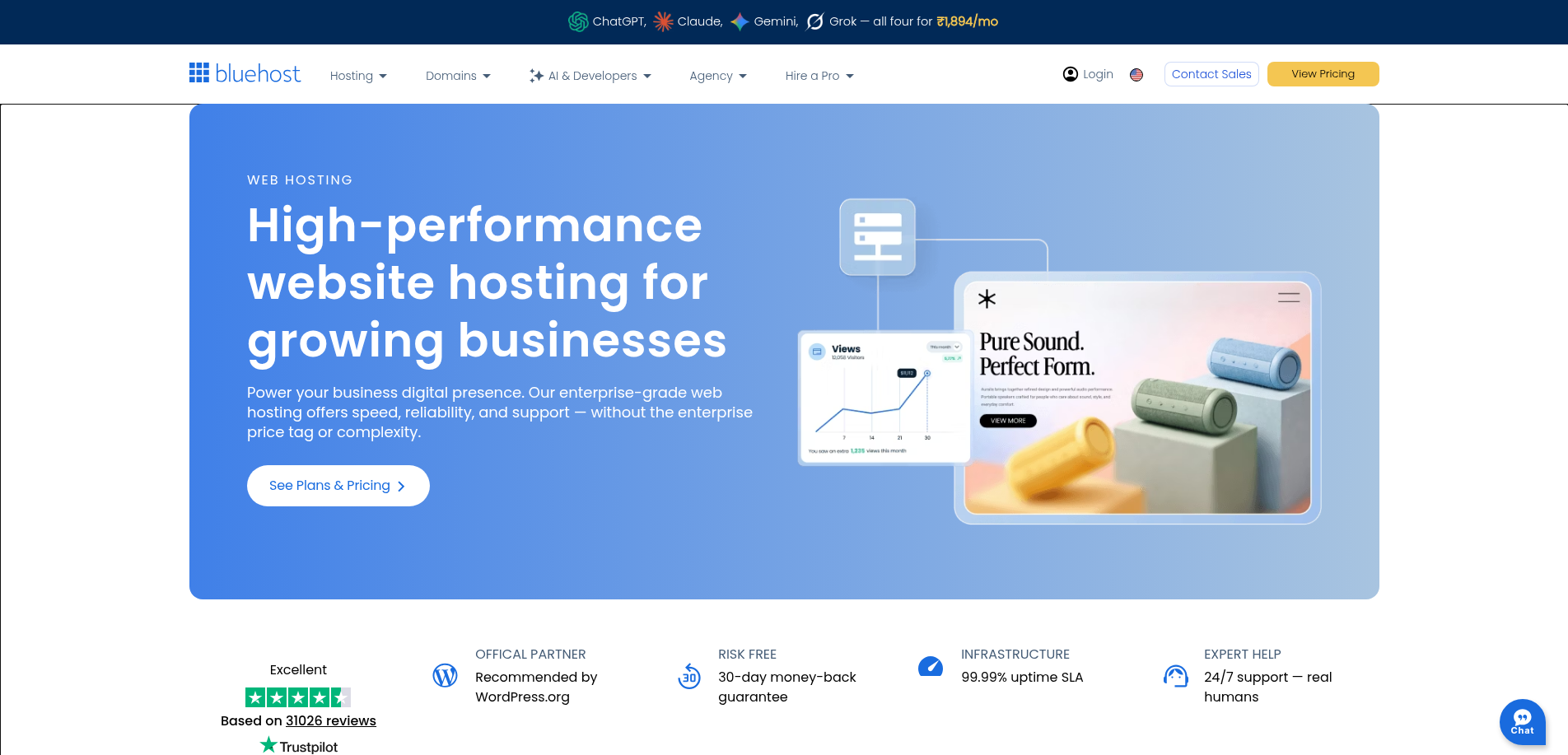
Bluehost is WordPress.org's officially recommended host, and it shows in how tightly its plans integrate with WordPress one-click install, automatic updates, and staging environments on higher tiers.
Price starts at: $2.95/month
Best for: Bloggers, creators, and small business owners building exclusively on WordPress.
Core Features & Infrastructure:
- Officially recommended by WordPress.org, featuring automated core updates and streamlined plugin management dashboards.
- Bundles a free domain name for the first year, a free SSL certificate, and multi-site management options for up to 10 websites on baseline tiers.
- 24/7 dedicated WordPress chat support.
5. A2 Hosting
A2 Hosting is best known for raw page-load speed, backed by SSD storage across every plan and (on most tiers) unlimited storage rather than a fixed cap.
Price starts at: $2.99/month
Best for: Small business owners prioritizing high-speed server response times and robust email handling on single-core sites.
Core Features & Infrastructure:
- Optimized infrastructure tuned for fast time-to-first-byte (TTFB) and high-speed data retrieval.
- Automatic routine backups and free SSL encryption included across plans.
- Fine-grained control over PHP versions and developer resources even on entry-level shared tiers.
Importance of Web Hosting

If you've just started building a website, web hosting may not be on your mind. Let's explain it simply.
When you create a website, you're essentially creating a set of files. To put them online, they need to be stored somewhere; that's where a hosting provider comes in. You pay them to "host" your files on their servers.
The advantage of using a hosting service is that your files stay accessible around the clock, day or night, without you needing to run your own server. Your hosting provider also handles server repairs, hardware and software updates, and troubleshooting to keep your website alive and running.
Essential Factors to Consider for Small Business Web Hosting

Uptime
A 99.9% uptime guarantee means your website stays available to users, minimizing disruptions. Downtime is costly and can damage your brand's reputation; anything below 99.5% should be treated as a red flag.
Performance
Fast page loads lead to happier customers and better search rankings. A good hosting provider ensures fast server response times and uses technologies like Content Delivery Networks (CDNs) for quicker loading, especially for visitors farther from the server's location.
Security Features
The safety of your data is non-negotiable. Look for a provider offering free SSL certificates, advanced firewalls, and malware protection as standard, not as a paid add-on.
Customer Support
Choose a provider offering 24/7 support across multiple channels live chat, phone, and email so problems get solved without delay.
Cost and Budget
Cost matters, but it shouldn't be the only factor. Balance your budget against the features your business actually needs. Check renewal pricing, not just the introductory rate, and look for discounts on longer-term plans if you're confident in the provider.
Scalability
As your business grows, your hosting should let you upgrade storage, bandwidth, and performance without forcing a full migration to a new provider.
AccuWeb Hosting covers these bases with free SSL certificates for security, a 99.9% uptime guarantee, daily backups for data protection, and multiple support channels for fast assistance.
Conclusion
In 2026, choosing a web hosting service is one of the most important decisions a small business will make. The options above balance cost, dependability, and the core features small businesses actually need, from uptime and security to support and room to grow. Start by identifying which hosting type fits your traffic and technical needs, then compare providers on renewal pricing and support quality, not just the sign-up price. With this understanding of the best web hosting solutions for small business websites, you can find the one that aligns with your goals.
Happy Hosting!
Frequently Asked Questions
How much bandwidth does a small business website actually need?
Most small businesses with basic needs a standard website, some cloud tools, and light email use do fine with 100 Mbps bandwidth. If your site handles a lot of video, high-res images, or frequent large file downloads, you'll want to size up.
Is shared hosting secure enough for a small business?
Yes, for most small business sites. Reputable shared hosting providers isolate accounts from one another and include SSL, firewalls, and malware scanning as standard. If you handle sensitive customer data (like payment details) at scale, consider VPS or dedicated hosting for extra isolation.
What's the difference between introductory pricing and renewal pricing?
Introductory pricing is a discounted rate for your first billing term (often 12–36 months). After that, your plan renews at the standard rate, which can be significantly higher. Always check the renewal price before signing up so you're not surprised later.
Do I need a free domain, or should I buy one separately?
A free domain bundled with your first year of hosting is a nice cost-saver, but check the renewal price for the domain too; some providers charge more to renew a domain than to register it fresh elsewhere.
When should I upgrade from shared hosting to VPS or cloud hosting?
Consider upgrading if you're consistently seeing site slowdowns during traffic spikes, approaching 20,000+ monthly visitors, or running resource-heavy features like a large online store. A good provider will let you upgrade without migrating your site elsewhere.
Does my hosting provider affect my SEO?
Yes, indirectly but meaningfully. Site speed and uptime are both factored into how search engines rank pages, and a slow or frequently down site also increases visitor drop-off, which hurts rankings.
About the Author: Jason-Pat
Founder & CTO at AccuWebHosting.com. He shares his web hosting insights at AccuWebHosting blog. He mostly writes on the latest web hosting trends, WordPress, storage technologies, Windows and Linux hosting platforms.